In Iran, the War Is No Longer Just on the Battlefield
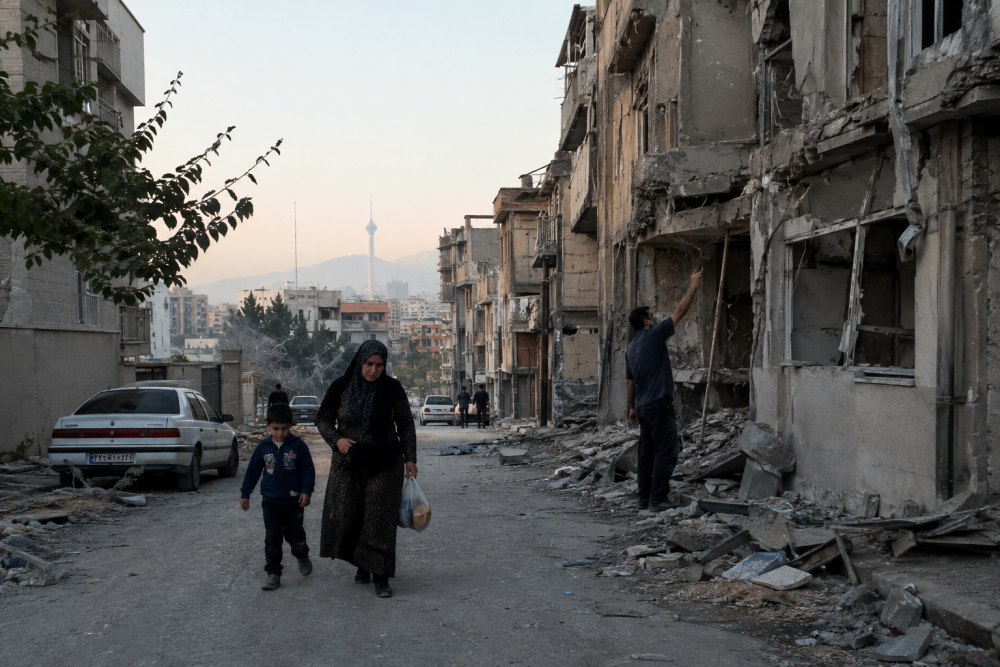
Tehran, Iran – Tooba Moshiri
With the first wave of US and Israeli attacks on Tehran and other Iranian cities in the early hours of February 28, 2026, life in Iran was abruptly transformed. For people across the country, the war was not only a matter of military strikes and political developments, but something that quickly entered their homes, workplaces, businesses and daily routines. Fear, uncertainty and economic pressure began shaping decisions that had little to do with the battlefield itself, from whether to leave their cities to how to work, communicate with relatives abroad or afford everyday necessities.
Over the months that followed, the nature of these pressures changed, but the sense of uncertainty remained. The experiences of those days offer a picture of how a prolonged conflict can continue to affect ordinary lives long after the sound of explosions has faded.
Three Phases of a War That Has Yet to End
The first was the early days of the war, which, despite months of speculation about the possibility of renewed military confrontation following the 12-day war with Israel, plunged many people into shock. The scale of the attacks was greater, both in intensity and geographical reach, and this time the United States was directly involved from the very first day, rather than the attacks being limited to Israel.
The attacks began amid threats from US officials to destroy Iran’s nuclear capabilities and bring down the Islamic Republic. Yet the targeting of civilians from the very first day left many people stunned. Missile strikes hit the Shajareh Tayebeh elementary school in Minab County, in southern Iran near the Strait of Hormuz and the Persian Gulf, killing 156 civilians, including 120 schoolchildren. Another missile strike hit a sports club in Lamerd County, killing 21 people and injuring more than 100 others.
The second phase, after around 40 days of war, was the ceasefire announced unilaterally by Donald Trump on April 7, 2026. The ceasefire, which months later led to the signing of an agreement between the two sides, did little to bring an end to the exchange of fire between Iranian and US forces. While the agreement initially raised hopes among many people that peace might return, it was not long before the two sides accused each other of violating its terms and continued the tensions and clashes.
The final phase is marked by economic pressure and growing anticipation and speculation about a renewed war. Economic pressure has resulted from sanctions that have gradually intensified against Iran during this period, as well as a naval blockade that has reduced Iran’s revenues from the sale of petroleum products, directly affecting the economy and inflation. The blockade has also disrupted the import and export of non-oil goods by sea, contributing to further price increases.
When War Entered Everyday Life
“The sound of explosions could be heard in the distance, while those closer by shook the house. Fighter jets could be heard overhead, and when you looked out over the rooftops, columns of smoke were visible all around.” This is how Aria describes those days.
The tall 28-year-old, who works in commercial photography, decided to remain in his home in Tehran despite the risks posed by air strikes and not leave the city.
“Some people had left the city to seek refuge in safer towns and villages. But compared with the 12-day war with Israel, more people had chosen to remain in Tehran this time, like me. The city had entered a semi-shutdown state, and businesses, shocked by the war, were either closed or had changed their working hours and services. But I wanted to stay and witness what was happening in my city firsthand.”
Aria says that most of his friends who had temporarily left Tehran gradually returned, while continuing to call him several times a day out of concern to learn about the latest developments in the capital.
International internet access was also cut during the first weeks of the war for security reasons, making it impossible for many people to communicate with relatives and friends abroad, adding to their anxiety.
Sobhan, another man in his early thirties, whose brother lives in Germany, says it took a long time before he was able to contact his family and reassure them that they were safe. Sobhan, who sells decorative ceramic products through social media, lost both work and income during that period. He recalls the problems caused by the internet shutdown:
“The only way to contact people abroad was through the Starlink internet, but possessing Starlink equipment in Iran is illegal and can lead to prosecution. The Iranian authorities have banned its use, arguing that the service can be used for terrorist and sabotage activities.” Businesses that depended on the internet had effectively come to a standstill, and people who relied on them for income could no longer earn a living, making the situation even more difficult. Using accessible domestic Iranian platforms was time-consuming and required advertising and starting over from scratch. In any case, the tense atmosphere of war left little motivation to work.”
In the early days of the war, people rushed to stores out of fear that food and hygiene products might become scarce, making large purchases and stocking up on supplies. Atefeh, a homemaker and mother of a six-year-old daughter who lives in northwestern Tehran, was among them. She recalls:
“There was never really a shortage. Only on the first day, when people were making panic purchases, some shelves were emptied, but they were quickly restocked, and almost nothing ever became unavailable. After a few weeks, people realized that their concerns had been unfounded, and stores continued operating as usual.”
A Ceasefire That Never Felt Like Peace
Bahador, the owner of a shoe shop in Tehran’s Ferdowsi neighborhood, recalls the days of the ceasefire:
“The ceasefire was only a ceasefire in name. Of course, it should be said that after the ceasefire, attacks on Tehran did not resume except on a limited number of days. But from then until today, we have constantly seen reports of exchanges of fire, while the southern parts of the country have come under heavy attack. Every time the Americans launch an attack, many people’s lives are affected and disrupted. This makes the ceasefire meaningless.”
Originally from Rudan County in southern Iran’s Hormozgan Province, he says that an attack on any part of Iran is an attack on the whole country, and that the fact that the attacks have been limited to other areas does not make people feel that the war is over or that life has returned to normal. “So for many people, including me, the ceasefire is not real. The war is still going on.”
He also has views on the Islamabad Memorandum and its provisions:
“From what I understood, it was a very good agreement that was in Iran and its people’s interest. From ending the sanctions to unfreezing blocked funds, all of it could have helped the fragile economy and potentially led to economic growth. But it seems that agreement was never implemented either, becoming, like the ceasefire, little more than a headline in the news, without having any real impact on our lives in Iran.”
The War’s Impact on Jobs and Businesses
Aria says that after tensions largely subsided and people returned to their homes and everyday lives, another consequence began to emerge: layoffs and a shortage of projects. This was the result of companies and businesses suffering losses during the early days of the war and being forced to shut down. As a result, people working in virtually every sector have felt the negative impact on their livelihoods.
This wave of layoffs, unlike the economic difficulties of the past, which unfolded gradually and could be anticipated, was faster and broader in scale because of the sudden and severe pressures caused by the war.
According to Iran’s domestic Etemad newspaper, preliminary estimates indicate that the war resulted in the loss of more than one million jobs and directly and indirectly left two million people unemployed. The figures were cited by Gholamhossein Mohammadi, deputy minister of Cooperatives, Labour and Social Welfare, on April 20, 2026.
Seyyed Morteza Mahmoudi, a Tehran MP, recently attributed the difficult conditions in the labor market and production sector to two main factors: first, the effects of the war, and second, the economic pressures that have been imposed. In addition to the problems caused by the war, which are already evident, he explained the second factor as follows: “Higher wages, rising taxes, increased insurance costs, higher prices for raw materials, difficulties in securing financing and a shortage of working capital have sharply increased production costs. At the same time, many businesses are unable to fully pass these costs on to the final price of their goods, leaving them in a difficult position.”
The Rising Cost of Survival
Prices and inflation have now reached their peak since the early days of the war. The depreciation of Iran’s national currency has been dramatic. The dollar is currently trading at around 2,938,000 rials, compared with 1,650,000 rials in Tehran before the war began.
Atefeh says the prices of basic goods, according to figures released by Iran’s National Statistics Center, have risen by triple-digit percentages, and many households have cut back on their purchases of chicken, meat and dairy products. Frustrated, she continues: “The price of a fixed basket of food has at least doubled compared with the same period last year. For a household with a fixed income, this gap can only be addressed by consuming less or switching to cheaper products.”
Pedram, an economic analyst, predicts that before the end of the year, both point-to-point and annual inflation will reach triple digits. He says the future inflation rate will depend on the country’s current conditions. If the current situation continues, even under the best-case scenario, monthly inflation could remain in the range of 7 to 8 percent.
He also offers a more optimistic scenario: if the war ends and conditions improve, monthly inflation could eventually remain around 3 percent, despite the government’s budget deficit. Even in that case, however, point-to-point inflation could reach around 60 percent by the anniversary of the start of the war in February, while annual inflation could reach around 80 percent.
He adds, however: “Even a monthly inflation rate of 3 percent is extremely high. That level is roughly equivalent to the annual inflation rate considered the threshold of tolerance for many countries.”
Sobhan, who says his sales of ceramic products have declined compared with before the war, says Iranians have become accustomed to dealing with sanctions and constantly rising prices. But he says the fact that everything keeps becoming more expensive, with new price records being set, is worrying.
“The warning signs of poverty are becoming increasingly clear, and that is discouraging for a nation with such vast energy resources.”
Trading Under a Blockade
Iranian President Masoud Pezeshkian recently described the recent price increases and their impact on people’s livelihoods as “natural” during a meeting with the secretaries-general of political parties and political activists, attributing them to the economic blockade and US oil sanctions. He said: “Previously, imported goods came by ship; now they have to pass through many routes before entering the country, driving up the final cost of goods. Our income has also declined. We used to sell oil; now we cannot sell it.”
Ahmadreza Farshchian, a member of the Iran Chamber of Commerce’s board of representatives and chairman of its Import Management Commission, has spoken to Iranian media about the impact of the naval blockade on the country’s foreign trade. He says that despite the US naval blockade, Iran’s foreign trade will not come to a complete halt because the country’s trade routes are not limited to the sea. Part of Iran’s trade is conducted through rail and road routes, while northern routes are also used for this purpose.
He adds, however: “Of course, continuing trade through alternative routes does not mean there are no problems. The restrictions that have been imposed will make trade more difficult and will probably reduce part of the overall trade volume, but a complete halt to trade will not happen.”
It appears that government officials are trying, as they have in the past, to find alternative routes and ways to circumvent sanctions alongside the naval blockade, in an effort to limit the problems facing the country and reduce their impact on people’s lives.
Government Steps to Ease the Economic Pressure
The government has taken measures to mitigate the economic consequences of the war, including unemployment and rising prices. Ahmad Meydari, the Minister of Cooperatives, Labour and Social Welfare, says the government and parliament are seeking to ease the burden of higher prices by increasing the value of the kalabarg, a government food voucher that allows eligible households to purchase essential goods such as bread, rice, cooking oil and dairy products. The amount is linked to a household’s income decile. On average, each eligible household member receives 10 million rials in monthly credit, equivalent to around €3.30.
After months of speculation, the government has also developed a new formula to strengthen the purchasing power of vulnerable groups. According to Abdolnasser Hemmati, the Governor of the Central Bank, the government is currently working to secure the funds needed to increase kalabarg credit by 50%.
However, many within the government establishment also consider this insufficient. Nader Ebrahimi, a member of parliament representing Arak, says wages should be increased and the value of the kalabarg and cash subsidies should be at least tripled. “Increasing people’s incomes is not merely a welfare policy; it is also an economic and productive policy,” he says. “By increasing purchasing power, the market grows. Therefore, increasing wages does not add to inflation; purchasing power returns to the economy, and Iranian families can live with dignity and peace of mind.”
On unemployment, government officials recognize that preserving existing jobs during wartime is one of the most important ways to prevent the shock of war from reaching households and businesses. In the days and weeks after the ceasefire, economic policymakers therefore introduced a series of support measures aimed at keeping businesses operating and easing the pressure created by the emergency.
One of the main initiatives was a programme to support employment at affected businesses through the “Entrepreneurship, Employment and Production” — or Kat — online system. Designed and launched in less than a month, the programme aims to prevent workforce reductions and help economic units maintain their operations.
As falling revenues and disruptions to business activity can push companies to cut costs and lay off workers, providing liquidity to affected businesses has become particularly important. The government says its financial support is not only intended to provide businesses with funding, but also to preserve their production and service capacity and protect existing jobs.
Nevertheless, difficult days are unfolding for people across Iran. The explosions may have become less frequent, but the uncertainty surrounding the war has not disappeared. For many, it has simply taken a different form — from worries about renewed attacks to rising prices, lost jobs and an increasingly difficult struggle to afford everyday life.
As people wait to see whether the confrontation with the United States will escalate again or whether a lasting agreement can finally bring stability, the consequences of the past months continue to shape their lives. For now, the war may no longer be heard every day from the rooftops of Tehran, but its effects are still being felt in homes, workplaces and markets across the country.